
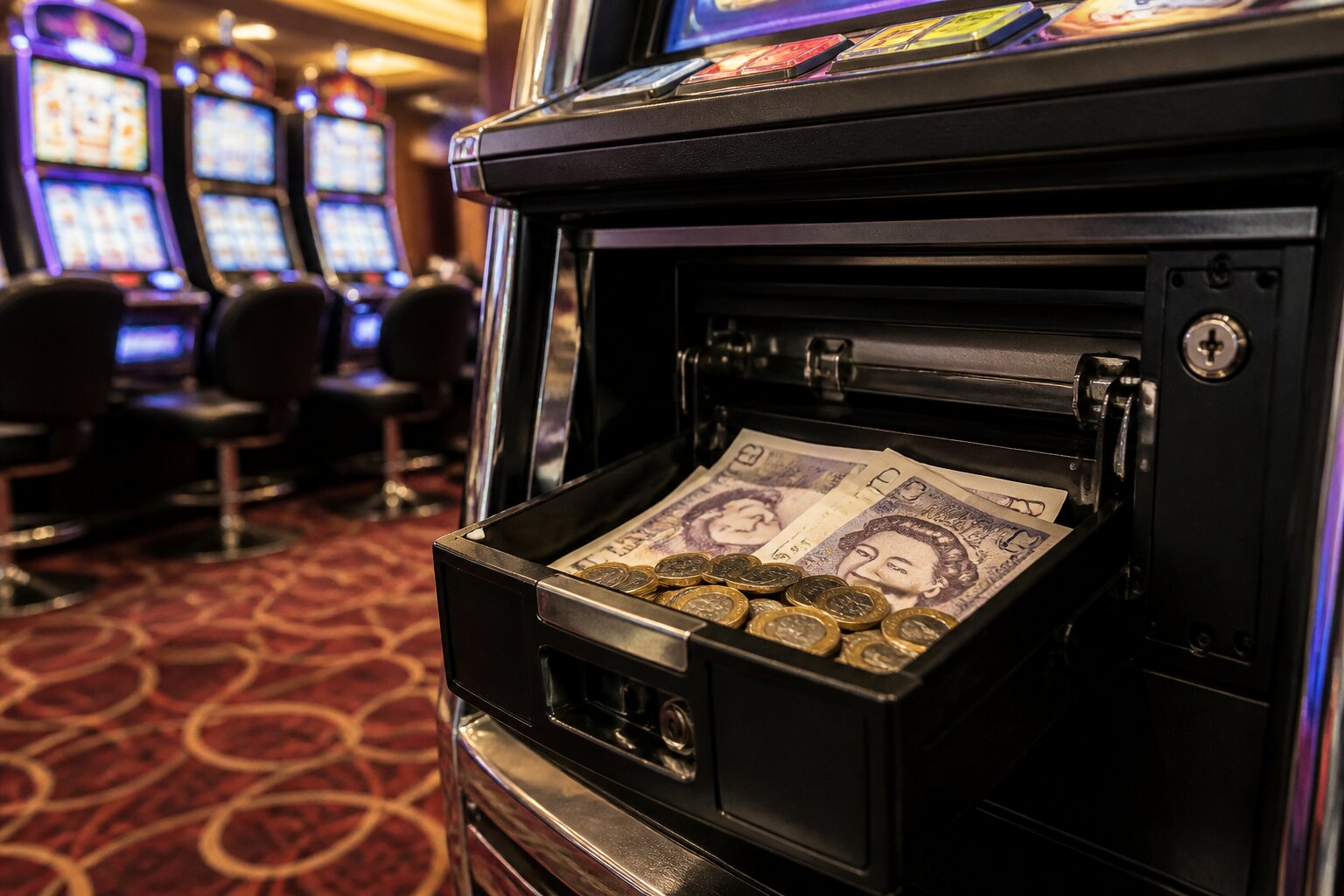
Ever stared at a slot machine and wondered just how much cash it could possibly fit inside? That glowing cabinet on the casino floor, or its high-tech online slot cousin, is designed to handle a constant flow of coins, notes, or digital credits – but every machine has its limit.
Whether you’re feeding pound coins into a fruit machine down your local pub or tapping to spin on an online slot, there’s always a point where the system needs a top-up or a cash-out. The answer isn’t a single figure: understanding a slot’s cash capacity involves machine design, operational procedures and the regulatory framework that governs payouts. Read on to see how these elements work together and what happens when a machine reaches its limit.
What Determines a Slot Machine’s Maximum Capacity?
The most obvious factor in a machine’s capacity is the physical cash box: its size, shape and how it’s fitted into the cabinet. Smaller pub fruit machines typically use compact boxes sized for pound coins, whereas casino-grade models are built with larger receptacles to cope with heavier turnover and higher denomination notes.
Beyond the box itself, the machine’s intended environment shapes its design. Models destined for busy casino floors are engineered for rapid servicing: removable cash boxes, quick-access locks for authorised staff, and reinforced mounts to deter tampering. Conversely, machines for community clubs or arcades are often older or simpler, with smaller capacities and more frequent emptying.
Technology also plays a role. Modern machines include sensors and digital counters that log coin and ticket intake, while ticket-based systems reduce the need for large cash reserves. Finally, practical policies influence how full a machine ever gets: operators typically empty or swap boxes before they reach physical maximums, both to maintain play and to reduce security risks.
These technical and operational features lead directly into the legal and procedural controls that govern how much a machine may hold at any one time.
How Much Cash Can a Slot Machine Legally Hold?
There isn’t a single statutory cash limit stamped on every machine, but legal and licensing requirements set clear boundaries that operators must follow. Machines are classified by category, and those classifications drive the permissible stakes, prizes and, importantly, the practical controls on cash handling.
For lower-category machines found in pubs and arcades, the cash boxes are small by design and frequent emptying is the norm to keep amounts low. Higher-category machines in casinos will typically have larger capacity components, but operators use strict internal controls to avoid excessive amounts accumulating. Large payouts above defined thresholds are often handled at a cash desk rather than being paid directly from a machine, so stored cash rarely needs to cover very large wins.
Regulatory expectations require accurate meters and audit trails for cash and ticket movements. Staff procedures—including two-person handling for removals, sealed transfer containers and detailed logs—reduce the chance of discrepancies and make it unnecessary for machines to be filled close to their maximum physical capacity. Local licensing conditions and operator policies may add further restrictions, so the practical upper limit is as much about process as it is about metal and plastic inside the cabinet.
Types of Slot Machines & Their Storage Limits
Slot machines vary widely, and the way they store and deliver value reflects their type.
Mechanical reel machines are the traditional fruit machines. They mainly accept and pay out coins and tend to have modest cash boxes; a typical unit might hold a few hundred pounds in coinage before requiring emptying. These simpler machines are straightforward to service but need more frequent attention in busy locations.
Video slots use digital screens and accept a wider range of inputs, including notes and ticket vouchers in some venues. Their cash boxes are generally larger than those of mechanical units because they cope with higher stakes and more frequent cash handling. Even so, security considerations keep how much is left in a machine deliberately conservative.
Ticket-In, Ticket-Out (TITO) systems change the picture. With TITO, machines dispense a printed ticket or electronic voucher instead of cash. This reduces the need for large cash reserves inside machines and makes payout handling quicker and safer. TITO systems still require a small float for low-value transactions or change, but the bulk of monetary value is managed electronically or in a centralised cash handling area.
Understanding these types helps explain why machines are rarely filled to their maximum: design, payout methods and routine servicing all mean cash levels are kept deliberately moderate. The next section looks at what happens when those safeguards are exhausted and a machine actually becomes full.
What Happens When a Slot Machine Is Full?
Modern machines are fitted with sensors and software that detect when a cash or ticket box reaches capacity. When that threshold is met, the machine will usually halt acceptance of further notes or coins and display an error or maintenance message on its screen.
Staff response follows established procedures. A supervisor or authorised technician will inspect the machine, confirm the condition and remove the cash or ticket box. For security and auditing purposes the removal is typically carried out by two staff members; the box is sealed, logged and taken to a secure counting area. The machine is inspected, any fault codes cleared and operational checks performed before it is returned to play.
From a player perspective, the visible effects are straightforward: the machine displays a message, and play is suspended until staff resolve the issue. Behind the scenes, the emphasis is on maintaining accurate records and ensuring funds are handled securely, so downtime is minimised while accountability is preserved. With ticket systems, a machine that can no longer print or read tickets will likewise be taken out of service until the fault is cleared.
Knowing how full machines are dealt with in practice highlights the careful balance operators strike between keeping machines available and protecting cash and players, which is why cash levels are actively managed rather than simply left to reach maximum capacity.
How Do Casinos Manage Slot Machine Money Levels?
Casinos combine hardware, software and routine processes to keep machine cash at appropriate levels. Digital meters and networked monitoring give operations teams a continuous view of each machine’s intake and ticket levels, allowing staff to plan collections before any single machine becomes overloaded.
Collection teams follow schedules informed by footfall and machine performance: busy areas may be serviced multiple times a day, quieter locations less often. When boxes are removed, the chain of custody is documented—sealed containers, staff signatures and timestamped entries into logging systems. The sealed boxes are taken to secure counting rooms where detailed reconciliation is performed and any anomalies are investigated.
These procedures serve practical and regulatory purposes. They maintain machine availability, protect against theft or human error, and support the accurate financial reporting that regulators require. By combining automated alerts with disciplined handling routines, operators keep cash levels manageable and machines running smoothly for players.
Myths & Common Questions About Slot Payouts
Slots attract plenty of myths about payouts and machine contents. A few common questions come up repeatedly, so it helps to clear them up with how machines actually work.
Does a full machine mean it’s due to pay out? No. The outcome of each play is determined by the game’s internal system and payout structure; the physical amount of cash in the box doesn’t change those programmed odds. Machines are designed so results are independent of the cash level held inside.
Can you win more if the machine holds more cash? Payout amounts are defined by the game rules and the machine’s configuration. Higher stored cash simply means the machine can process multiple payouts before emptying is necessary; it doesn’t make larger prizes more likely or increase payout percentages.
Why are some wins paid at the counter? For significant payouts there are practical and compliance reasons to pay at a supervised counter: it ensures proper documentation, identity checks if required, and secure handling of larger sums. This approach keeps the amount needing to be kept inside any one machine relatively small.
Clearing up these points helps demystify how machines operate, showing that design, rules and procedures—rather than the visible bulk of coins—determine how payouts are managed.
If you want to see the differences in how machines are served or how TITO compares to cash-only systems, our site has a dedicated comparison that explains what to expect in pubs, arcades and casinos.
Play Online Slots at Online Bingo
Fancy adding a bit more entertainment to your day? We welcome you to explore what our site has to offer and enjoy playing with us at your own pace.
Getting started is simple: just create an account, make your first deposit and you are all set to play. We look forward to seeing you discover the fun of our games.
**The information provided in this blog is intended for educational purposes and should not be construed as betting advice or a guarantee of success. Always gamble responsibly.