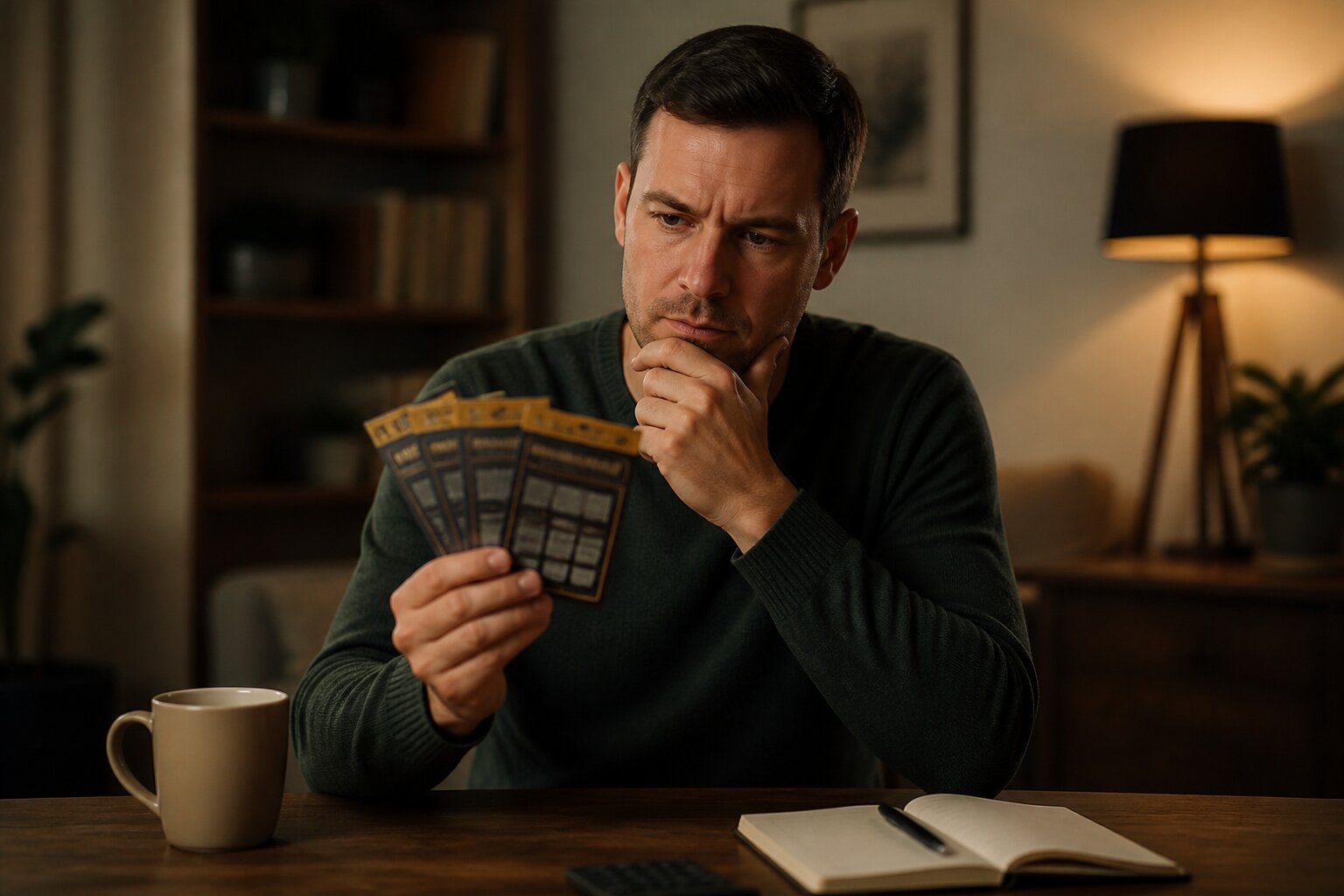
Ever found yourself standing in the shop, eyeing the scratch cards, and wondering if pricier options really give you better odds? You’re not alone — many people ask whether spending more increases the chance of a payout or simply raises the stakes.
Scratch cards are a familiar way to take part in games in the UK, but there’s more to them than bright designs and big prize amounts. Understanding how the games are structured will help you make informed choices and avoid unnecessary spending. Ready to find out what really matters? Keep reading.
How Do Scratch Card Odds Work?
Odds on scratch cards show how likely it is that a ticket will win a prize. Game providers set these odds according to the number of winning tickets printed in each game’s overall run. Common formats are ‘1 in 4’ or a percentage such as ‘25%’. ‘1 in 4’ means that, on average across the whole print run, one ticket in every four pays out some prize; it does not guarantee that buying four tickets will produce one win.
Quoted odds usually refer to winning any prize, including the smallest amounts. The chance of landing the top prize is typically much lower and is often stated separately — for example, a top prize might be listed as ‘1 in 3,000,000’. Odds must be printed on physical tickets or displayed in game information online so they are available to check before playing.
Understanding these basics makes it easier to compare cheaper and more expensive tickets when deciding what to buy.
What Makes Expensive Scratch Cards Different?
Higher-priced scratch cards stand out because they generally offer larger top prizes and richer prize tiers than low-cost options. A £1 ticket will normally feature modest top prizes and many small payouts, while a £5 or £10 ticket will typically include higher-value prizes and more intermediate amounts.
More expensive games also often include extra features — additional mini-games, bonus panels or a second-chance element — which can make the experience feel fuller. Those additions change the way wins can present themselves, but they do not automatically increase the overall chance of winning a main prize. Always check the stated odds and prize table for each game before deciding which ticket to buy.
If you want to understand how these differences show up in returns to players, the next section explains payout percentages and what they mean in practice.
Payout Percentages: Do Higher Prices Mean Better Returns?
Payout percentage, commonly called Return to Player (RTP), indicates the proportion of money spent on a game that is returned to players as prizes over the entire print run. A higher ticket price can be associated with a higher RTP, but the gap is often modest and does not predict an individual’s result.
RTP is a long-term average. For instance, a £1 game might have an RTP around 60% to 65%, a mid-range £3 game near 68%, and premium £10 games sometimes reaching 70% to 75%. This means that for every £100 spent on a given game, the operator will return, on average, the RTP amount as prizes across all tickets sold; it does not mean any single player will recoup that share.
You can usually find RTP and odds printed on the back of physical tickets or on the game’s information page online. These figures are helpful for comparing games, but they are not guarantees of personal outcomes.
Does the Price Affect Jackpot Size and Prize Structure?
Ticket price has a clear effect on prize size and structure. Lower-cost tickets tend to offer a smaller top prize and a greater number of low-value payouts. Higher-cost tickets raise the ceiling for the jackpot and add more mid-range prizes, although the number of top prizes is limited and each one is rare.
Typical prize tiers for a low-cost ticket might include very small wins and one or two intermediate levels, whereas a high-cost ticket will add multiple higher-value tiers beneath a large top prize. As price increases, top prizes generally become larger, but the odds of winning those top prizes lengthen considerably.
Prize tables are available for each game so players can see how the money is distributed across prize levels; knowing this helps to set realistic expectations about what a higher spend can buy.
Are Your Chances Better with Multiple Cheap Cards or One Expensive Card?
With a fixed budget, choosing between many low-cost tickets and a single high-cost ticket changes both the pattern of possible wins and the scale of potential prizes. Buying several low-cost tickets increases the number of separate chances to win small amounts, while one expensive ticket concentrates that budget into a single chance at much larger prizes.
Statistically, multiple cheap tickets tend to yield more frequent, smaller wins, whereas a single premium ticket offers one opportunity for a larger payout but leaves you with a higher chance of winning nothing. Which approach suits someone depends on whether they prefer more frequent, modest returns or a single shot at a big prize. Either way, it’s sensible to set and stick to a budget so play stays affordable.
What Other Factors Influence Scratch Card Outcomes?
Besides price and stated odds, several practical factors shape how likely a player is to encounter particular prizes.
Number of tickets printed and remaining prizes are important. Each game’s print run contains a fixed number of top and other prizes. As tickets are sold and winners claimed, the pool of remaining big prizes changes. Some operators publish the count of outstanding top prizes, which can inform buying decisions if you want to know whether major prizes are still available.
Game design also matters. Simple formats award prizes when particular symbols match, while more complex games include bonus panels, multipliers or instant-win features. These elements alter how winnings are delivered but not the underlying distribution of prizes. Together, the print run size, outstanding prize counts and game format create the real-world landscape that determines what outcomes are possible.
Myths About Scratch Card Winnings
Below are common misconceptions and short explanations of why they are incorrect.
- Buying tickets at certain times increases the chance of winning: timing does not affect outcomes; ticket results are determined by the game’s design and distribution, not by when a purchase is made.
- Shops or retailers keep winning tickets back for themselves: distribution of tickets is handled by suppliers, and retailers do not control which tickets are winners.
- More expensive tickets always mean bigger or more frequent wins: higher prices raise prize sizes but do not guarantee more frequent wins; top prizes remain rare.
- Buying from a particular shop after someone else loses improves your chances: each ticket is independent; previous outcomes do not influence future ones.
- Systems or methods can beat the odds: licensed games are structured so there is no reliable strategy to change the statistical chance of winning.
These points reflect the regulated approach to game fairness and the predictable nature of how prizes are distributed.
Every scratch card game comes with published odds and prize tables. Use those figures to compare options and keep spending within your means.
Play Casino Games Online at Online Bingo
We’d love to welcome you into our community at Online Bingo, where everyone can come together and enjoy a friendly, relaxed gaming atmosphere. You’ll always find a place with us, no matter your level of experience.
**The information provided in this blog is intended for educational purposes and should not be construed as betting advice or a guarantee of success. Always gamble responsibly.